
The Jordanian Royal Family: The Complete Guide to the House of Hashim
Every Member. Every Branch. Every Scandal. 1,400 Years of the World’s Most Remarkable Dynasty — From the Arab Revolt to the 2026 Royal Twins.
Last Updated: September 2026 | 25-minute deep read | Fully Researched & Fact-Checked Against rhc.jo
📋 What’s In This Guide
- Ancient Lineage: 1,400 Years of Hashemite History
- Sharif Hussein and the Great Arab Revolt (1916)
- T.E. Lawrence of Arabia — The Haunted Officer
- King Abdullah I: Founder, Diplomat, Assassination Victim
- The 1951 Coup Attempt: Prince Nayef’s Power Grab
- King Talal, Queen Zein al-Sharaf, and the 1952 Crisis
- Prince Hassan bin Talal: The Crown Prince They Took Away
- Princess Basma bint Talal: The Reform Princess
- King Hussein bin Talal: 46 Years, 4 Wives, 12 Children
- The Dark Secret: Susan Cabot, the CIA, and King Hussein
- King Abdullah II and Queen Rania: Jordan’s Modern Monarchs
- Crown Prince Hussein and Princess Rajwa
- Princess Iman bint Abdullah II and Jameel Thermiotis
- Princess Salma: The Fighter Pilot Princess
- Prince Hashem: Regent at 18
- Princess Haya and the Dubai Court Scandal
- Prince Ghazi bin Muhammad: The Scholar Who Changed Interfaith History
- Prince Ali bin Hussein: The FIFA Challenger
- Prince Hamzah’s Full Family — 7 Children Named at Last
- Who Is Who: Navigating the Repeated Names
- Frequently Asked Questions
The House of Hashim claims direct descent from the Prophet Muhammad across 41 documented generations — a lineage spanning 1,400 years, meticulously recorded by the Royal Hashemite Court. They held the guardianship of Mecca for almost a thousand years. They launched the Arab Revolt of 1916. They survived assassination, coups, civil war, nuclear-era assassination attempts, palace intrigue that would embarrass the Windsors, a CIA-arranged romantic liaison in 1959 Long Island, and a 2021 sedition plot that ended with a prince under house arrest and his mother appealing to the world from her Twitter feed. And today they rule from a kingdom hemmed by war on every side, hosting 1.3 million Syrian refugees, while a Crown Prince with a Harvard-polished Saudi bride rides a 1984 open-top Range Rover through cheering Amman crowds, and his youngest brother serves as Regent of the entire country at age 18.
This is their complete story. Every branch. Every member. Nothing softened. Nothing left out.
Ancient Lineage: 1,400 Years of Hashemite History
The name “Hashimite” traces to Hashim ibn Abd Manaf, great-grandfather of the Prophet Muhammad, born around 464 CE. A leader of the Quraysh tribe in Mecca, he established the famous Ilaf (trade agreement) that gave Mecca’s summer caravans access to the Byzantine Levant and winter caravans to Yemen. His descendants became the Prophet’s own family. The lineage runs Hashim → Abd al-Muttalib → Abdullah → The Prophet Muhammad (570–632 CE). Through the Prophet’s daughter Fatimah and her husband Ali ibn Abi Talib came sons Hasan and Hussein. Jordan’s Hashemites descend through the Hasanid line — descendants of Hasan — conferring the title Sharif (noble).
For roughly 900 years, from the 10th century to 1924, the Hashemite family served as the hereditary Sharifs and Emirs of Mecca, protecting the holy cities and managing the Hajj pilgrimage. They answered to the Abbasid Caliphs, the Fatimids, the Mamluks, and finally the Ottoman Empire — but their sacred authority was their own. According to the Royal Hashemite Court’s official records, King Abdullah II is the 41st direct descendant of the Prophet Muhammad. His son Crown Prince Hussein is the 42nd.
Sharif Hussein bin Ali and the Great Arab Revolt (1916)
Hussein bin Ali al-Hashimi (c.1853–1931) was born in Constantinople and installed as Sharif and Emir of Mecca by the Ottoman Sultan in 1908. By 1914 the relationship with Istanbul had curdled. Through the Hussein-McMahon Correspondence of 1915 — ten letters with British High Commissioner Henry McMahon — Britain made sweeping and deliberately ambiguous promises of Arab independence in exchange for revolt against the Ottomans. On June 10, 1916, Hussein fired a rifle shot from the window of his palace in Mecca. The Great Arab Revolt had begun.
His armies, led by his sons Faisal and Abdullah, waged brilliant guerrilla warfare across 1916–18. The most audacious single act was the capture of Aqaba on July 6, 1917 — a 600-mile overland march across the Nefud Desert, considered impossible in summer heat, delivering Arab forces behind the Ottoman garrison. But while the blood flowed, diplomats were carving the region without them. The Sykes-Picot Agreement of 1916 divided Arab lands between Britain and France. The Balfour Declaration of 1917 promised a Jewish national home in Palestine. When the Bolsheviks published Sykes-Picot in November 1917, Arab fury was total — and justified.
Hussein declared himself “King of the Arab Countries.” The British recognised only “King of the Hejaz.” His final fate was grim: in 1924–25, Ibn Saud’s forces swept through and conquered the Hejaz. Hussein abdicated and fled. He died on June 4, 1931 in Amman — in the kingdom his son Abdullah had founded — and is buried in Jerusalem. The man who started the Arab Revolt died stateless.
The Four Sons of Sharif Hussein — and Their Fates
Ali bin Hussein (1879–1935): Briefly King of Hejaz (1924–25) before Ibn Saud’s forces overwhelmed him. Died in Baghdad 1935.
Abdullah bin Hussein (1882–1951): Became Emir, then King of Transjordan/Jordan. Founded the dynasty that rules today. Assassinated 1951.
Faisal bin Hussein (1885–1933): King of Syria (1920, expelled by France), then first King of Iraq (1921–33). The Iraqi Hashemite branch ended with the 1958 revolution and massacre.
Zeid bin Hussein (1898–1970): Diplomat and ambassador. His son Raad bin Zeid served as UN High Commissioner for Human Rights (2014–18).
T.E. Lawrence of Arabia — The Officer Who Called Himself a Fraud
Thomas Edward Lawrence (1888–1935) — Oxford archaeologist, British Army intelligence officer, guerrilla strategist, and the most famous non-Hashemite in the dynasty’s history. Assigned as liaison to Emir Faisal in October 1916, Lawrence identified what the British high command had missed: destroy the Hejaz Railway supply lines and the entire Ottoman garrison in Medina would wither without a single frontal assault. His strategy worked. His greatest personal feat was the Aqaba march — 600 miles through the Nefud in summer heat, thought impossible, pulling it off and then personally sailing to Cairo to deliver the news. His masterwork Seven Pillars of Wisdom is one of the great war memoirs of the 20th century, and also a document of private anguish: Lawrence knew he was manipulating Arab aspirations for British imperial ends and called himself, privately, “a complete fraud.” He died in a motorcycle accident in Dorset on May 19, 1935, age 46.
The Jordanian connection persists into the present dynasty. In 1961–62, King Hussein lent Jordanian Army troops to serve as film extras on David Lean’s epic Lawrence of Arabia. One of the production’s secretarial assistants was a young British woman named Antoinette “Toni” Gardiner, from Suffolk, England. She met King Hussein on the set. They fell in love. She converted to Islam, became Princess Muna al-Hussein, married the King in 1961 — and became the mother of King Abdullah II. A film set, a love story, a dynasty-shaping meeting.
King Abdullah I: Founder, Diplomat, Assassination Victim
Abdullah bin Hussein (1882–1951) was the second son of Sharif Hussein. After the French expelled his brother Faisal from Syria in 1920, Abdullah marched north with an army and threatened to take Syria back. The British — alarmed — arranged a deal at the Cairo Conference of March 1921. Winston Churchill, then Colonial Secretary, and Abdullah reached an agreement: Abdullah would govern the territory east of the Jordan River as an Emirate. The Emirate of Transjordan was formally established on April 11, 1921. Jordan gained full independence on May 25, 1946.
His Three Wives
Wife 1: Musbah bint Nasser (married 1904): Children — Princess Haya bint Abdullah (1907–1990), King Talal (1909–1972), Princess Munira (1915–1987, never married).
Wife 2: Suzdil Khanum (married 1913 in Istanbul): An Ottoman noblewoman who died at Raghadan Palace in Amman on August 16, 1968, and is buried in the Royal Mausoleum. Children — Prince Nayef bin Abdullah (1914–1983) and Princess Maqbula (1921–2001).
Wife 3: Nahda bint Uman (married 1949): From Anglo-Egyptian Sudan. Primary genealogical records indicate no children from this marriage.
In the 1948 Arab-Israeli War, his Arab Legion secured East Jerusalem and the West Bank — and with them the Islamic and Christian holy sites. In 1950 Jordan formally annexed the West Bank. Behind the scenes, Abdullah was conducting secret peace negotiations with Israel — including a meeting with Golda Meir, who reportedly disguised herself as an Arab woman to enter Jordan. For Arab nationalists, this was treason.
July 20, 1951 — Al-Aqsa Mosque, Jerusalem
It was Friday prayer time. King Abdullah walked toward the mosque doors accompanied by his 15-year-old grandson Prince Hussein. A 21-year-old tailor’s apprentice named Mustafa Shukri Ashu stepped from the crowd and fired at point-blank range. The King was struck in the head and chest and died instantly. The assassin was shot dead by bodyguards. A bullet aimed at young Prince Hussein struck the medals on his chest — the metal deflected it, saving his life. He had watched his grandfather murdered, and nearly died himself at fifteen. He wrote in his 1962 autobiography Uneasy Lies the Head: “I was fifteen, and death had reached out for me — and missed.” That moment forged the man he became for the next 48 years.
The 1951 Coup Attempt: Prince Nayef’s Power Grab
When Abdullah I was shot dead on July 20, 1951, his designated heir, King Talal, was abroad in Switzerland receiving psychiatric treatment for schizophrenia. Constitutionally, the next senior male became Regent. That was Abdullah’s son by his second wife Suzdil Khanum — Prince Nayef bin Abdullah (1914–1983). He was appointed Regent from July 20 to September 3, 1951. Then he made his move.
🔴 The Plot — and Why It Failed
Nayef enlisted Colonel Habis Majali and the 10th Infantry Regiment to surround government buildings and the palace of Queen Zein al-Sharaf — Talal’s wife, who was fiercely defending her husband’s constitutional right to the throne. Nayef intended to block Talal’s return and have himself crowned instead. The plan collapsed on two points:
- The British government refused to back it — Jordan was still heavily dependent on British military support, and London would not sanction a dynastic coup
- Glubb Pasha (General Sir John Bagot Glubb, commander of the Arab Legion) intervened decisively to uphold the constitutional succession
Nayef stood down. Talal returned on September 6, 1951 and took the throne. Nayef went into de facto exile in Beirut with his family. He eventually returned to Jordan but lived quietly. He died in Amman on October 12, 1983, age 68.
Nayef’s wife, Mihrimah Sultan (1922–2000), was a legitimate Ottoman princess — daughter of Şehzade Mehmed Ziyaeddin and granddaughter of Ottoman Sultan Mehmed V. (She is sometimes confused with the 16th-century Mihrimah, daughter of Suleiman the Magnificent — a completely different person from a different era.) Their sons were Prince Ali bin Nayef (b.1941) and Prince Asem bin Nayef (b.1948).
Prince Asem’s second wife, Princess Sana Asem (born Sana Kalimat, 1960, married 1986), is of Jordanian Circassian descent and highly active in representing the Circassian community in Jordan. Their children: Princess Salha (b.1987, married Mohammad Hashim Haj-Hassan 2011; children: Aisha, Hashim, Abdullah), Princess Nejla (b.1988, married Nasser Osama Talhouni 2014; children: Karimah, Shauna, Badiya), and Prince Nayef bin Asem (b.1998, married Sharifa Farah Alluhaymaq 2021).
Princess Nayef’s sister, Princess Maqbula bint Abdullah (1921–2001), married Prince Hussein bin Nasser (1902–1982) — who served as Prime Minister of Jordan twice (1963–64 and 1967) and as Lord Chamberlain of the Royal Court.
King Talal, Queen Zein al-Sharaf, and the 1952 Crisis
King Talal bin Abdullah (born February 26, 1909) became King on September 6, 1951 — the same day he returned from psychiatric treatment in Switzerland to reclaim his throne from his plotting half-brother. His reign lasted under a year but left a permanent mark: on January 1, 1952, he ratified the Constitution of 1952 — one of the most progressive legal frameworks in the Arab world at the time, establishing a constitutional monarchy with a bicameral legislature and guaranteeing civil rights including full rights for women. That constitution, amended many times since, still underpins Jordanian law today.
By mid-1952, Talal’s schizophrenia had become unmanageable — violent, unpredictable episodes that threatened both his family and the state. Parliament voted unanimously on August 11, 1952 to declare him mentally unfit and depose him. His son Hussein — just 16 — was proclaimed King. A Regency Council governed until Hussein formally assumed the throne on May 2, 1953. Talal was sent to a sanatorium in Istanbul, where he spent the remaining 20 years of his life. He died on July 7, 1972.
Queen Zein al-Sharaf bint Jamil (1916–1994): The Woman Who Saved the Throne
Currently unnamed in most accounts of this period, Queen Zein al-Sharaf was in fact the decisive political actor of 1951–53 — not a passive bystander. She defended the palace during Nayef’s coup attempt. She worked directly with Prime Minister Tawfik Abu al-Huda to have Talal’s condition documented and presented to Parliament. She supported the deposition — an extraordinary act of political courage toward her own husband, done to preserve the dynasty. And when 16-year-old Hussein became King, she effectively ran the Regency Council and held the state together for the year it took for him to come of age. She is also credited with influencing the inclusion of women’s rights provisions in the 1952 Constitution, and with founding the women’s branch of the Jordanian Red Crescent Society. Al-Malik Al-Insan — The Humane King — was shaped, more than anyone acknowledged in his lifetime, by his mother.
King Talal’s Children
King Talal and Queen Zein had four children. Their eldest son King Hussein is the subject of the next major section. The three others have received almost no coverage despite being significant figures:
Prince Muhammad bin Talal (born October 2, 1940 — died April 29, 2021, age 80): King Hussein’s younger brother. He served as Crown Prince of Jordan from 1952 to 1962 — not because the constitution required an older male (he was actually younger than Hussein), but because the 16-year-old King had no children of his own yet, making Muhammad the automatic heir. In 1962, when Abdullah II was born, Muhammad was naturally displaced as heir by the King’s own son. In April 1965, Hussein amended the succession rules to require an adult heir rather than an infant — and named his brother Hassan as Crown Prince instead of the 3-year-old Abdullah II. Muhammad served decades as a pillar of the Royal Court: Head of the Council of Tribal Chiefs (1971), Personal Representative of HM the King (1973–2021), Full General in the JAF. He died of natural causes on April 29, 2021 — the Royal Hashemite Court declared seven days of mourning. He had been married twice: to Firyal Irshaid (1964–1978, divorced), with whom he had sons Prince Talal bin Muhammad (b.1965) and Prince Ghazi bin Muhammad (b.1966); and to Taghrid Majali (1981–2021), daughter of former PM Hazza’ al-Majali, with whom he had daughter Princess Samiha Al Fayez.
Prince Hassan bin Talal (b.1947) — addressed in full in the next section.
Princess Basma bint Talal (b.1951) — King Hussein’s full sister, addressed below in her own section.
Prince Hassan bin Talal: The Crown Prince They Took Away
There is no more poignant figure in Jordanian royal history than Prince El Hassan bin Talal — the man who was Crown Prince for 34 years, four months, and seven days, and was removed by a scathing 14-page letter from his dying brother with less than three weeks left before the throne changed hands.
Born March 20, 1947, Hassan was educated at Harrow School (like King Hussein) and then at Christ Church, Oxford, where he studied Oriental Studies. He is a serious intellectual: author of multiple books on Middle East peace, Islamic ethics, interfaith dialogue, and economic development. He founded the Royal Scientific Society (Jordan’s premier applied research institution, 1970), the Arab Thought Forum (1981), and the Royal Institute for Inter-Faith Studies (1994). He speaks Arabic, English, Turkish, and French.
King Hussein named Hassan Crown Prince in April 1965, age 17, after amending the succession rules to require an adult heir rather than the 3-year-old Abdullah II. Hassan held the title for 34 years — through the 1967 war, Black September, the oil shock, the 1994 peace with Israel, and King Hussein’s lymphoma diagnosis in 1998. As Crown Prince he was Hussein’s deputy, Regent during foreign absences, economic planning chief, and the public face of Jordan’s intellectual and diplomatic engagement. He was deeply involved in the negotiations leading to the Wadi Araba Peace Treaty with Israel in 1994.
January 25, 1999 — The 14-Page Letter
King Hussein returned from the Mayo Clinic on January 19, 1999 — visibly weakened, clearly dying. Six days later, on January 25, he sent Hassan a 14-page handwritten letter stripping him of the Crown Prince title. The letter reportedly accused Hassan of: overstepping authority in military and government affairs; spreading gossip within the palace; treating the Royal Court as a personal fiefdom; creating tensions with other family members. The letter was leaked and published — humiliating Hassan publicly.
Multiple palace sources have since reported that Princess Sarvath (Hassan’s wife) played a catalytic role in precipitating the crisis — reportedly vetoing a compromise plan to name Prince Hamzah as Crown Prince, and (allegedly) beginning to redecorate royal residences as if she were already Queen, which infuriated the dying Hussein. Queen Noor was simultaneously lobbying for her own son Hamzah’s claim — creating two competing factions inside the palace. In the end, Hussein bypassed everyone and named his son Abdullah as heir. Thirteen days later, Hussein was dead.
Hassan responded with public dignity, accepted the decision formally, and — notably — when King Abdullah II faced the most dangerous internal crisis of his reign in April 2021, it was Hassan whom the King publicly trusted to lead the family mediation. On April 7, 2021, Abdullah stated: “I decided to deal with the matter of Prince Hamzah within the Hashemite family, and I entrusted this task to my uncle, His Royal Highness Prince El Hassan bin Talal.” The relationship is now one of respected elder statesman and nephew-king. In November 2021, Abdullah personally decorated Hassan with the Order of the State Centennial.
Princess Sarvath El Hassan and Their Four Children
Princess Sarvath El Hassan (born Sarvath Ikramullah in Calcutta) comes from one of Pakistan’s most distinguished diplomatic families. She married Prince Hassan on June 4, 1968, and served as Crown Princess for 31 years — running major educational and charitable initiatives throughout Jordan. Their four children:
- Princess Rahma bint Hassan (b.1969): Married Alaa Batayneh in 1997; two children.
- Princess Sumaya bint Hassan (b.1971): Married Nasser Judeh — Jordan’s former Deputy Prime Minister and Foreign Minister under King Abdullah II. Four children. Sumaya is President of the Royal Scientific Society and a leading STEM education advocate.
- Princess Badiya bint Hassan (b.1974): Married Khaled Edward Blair; one son. Lower public profile.
- Prince Rashid bin Hassan (b.1979): The most publicly active of Hassan’s children. Married Zeina Shaban in 2011 — a two-time Olympian who represented Jordan in table tennis. Sons: Hassan (b.2013) and Talal (b.2016).
Princess Basma bint Talal: The Reform Princess
Princess Basma bint Talal (born 1951) is the only daughter of King Talal and Queen Zein — King Hussein’s full sister, King Abdullah II’s paternal aunt. She holds a DPhil from Oxford University in development studies. She founded the Jordanian Hashemite Fund for Human Development (JOHUD) in 1977, chairs the Jordanian National Commission for Women, and has served as UN Goodwill Ambassador for UN Women and UNFPA and as Honorary Human Development Ambassador for UNDP. She is Jordan’s most prominent royal voice on women’s rights and poverty.
She has been married twice: first to Timoor Daghistani (children: Farah b.1971, Ghazi Daghistani b.1974); then to Walid al-Kurdi in 1980 (children: Saad b.1982, Zein Al-Sharaf b.1986). Her second marriage carries a shadow: Walid al-Kurdi, former CEO of the Jordan Phosphate Mines Company, fled to London in 2012 and was subsequently convicted in absentia for large-scale embezzlement — sentenced initially to over 37 years, with an additional 18-year sentence added later. Princess Basma has maintained her independent public standing despite this.
King Hussein bin Talal: 46 Years, 4 Wives, 12 Children
King Hussein bin Talal — born November 14, 1935 in Amman — became King at 16, having watched his grandfather murdered in a mosque and barely survived the same bullet. He reigned for 46 years. He survived at least 12 documented assassination attempts. He lost Jerusalem in 1967 through a military catastrophe and spent three decades trying to recover it diplomatically. He made peace with Israel in 1994. He appeared uncredited as an extra on Star Trek: Voyager in 1995 — a lifelong Trekkie. He flew himself everywhere, qualified on Cobras, Jet Rangers, and fixed-wing jets, and raced motorcycles for recreation. Jordanians called him Al-Malik Al-Insan — The Humane King.
Wife 1 — Queen Dina | Married April 19, 1955 | Divorced June 24, 1957
Sharifa Dina bint Abdul-Hamid (born Cairo, 1929) was a Hashemite princess, distant cousin of Hussein, and a Cambridge-educated English literature lecturer. She was 25; Hussein was 19. The political mismatch was as stark as the age gap: Dina was a sophisticated Nasserist intellectual; Hussein was charting a firmly pro-Western course. Divorced 1957. She later married a senior PLO commander. She died in Amman in 2019, age 89.
Child: Princess Alia bint Hussein (b. February 13, 1956)
Princess Alia’s life: Married Nasser Wasfi Mirza (1977–1988); son Hussein Mirza (b.1981), now President of the Jordanian Jiu-Jitsu and MMA Federation. Married Sayyid Mohammed Al-Saleh (1988–present); sons Talal (b.1989) and Abdul Hamid (b.1992). Founded the Princess Alia Foundation (PAF) in 2009 — animal welfare, wildlife rescue partnership with FOUR PAWS, equine therapy for autistic children. President, Royal Jordanian Equestrian Federation.
Wife 2 — Princess Muna al-Hussein | Married May 25, 1961 | Divorced December 21, 1972
Antoinette Avril Gardiner (born April 25, 1941, Chelmondiston, Suffolk) — daughter of a British Army Lieutenant Colonel, came to Jordan as a secretarial assistant on the Lawrence of Arabia production. Met King Hussein on set. Converted to Islam, became Jordanian citizen. After divorce retained her title, founded the Princess Muna College of Nursing and Allied Health Professions.
Children: King Abdullah II (b. Jan 30, 1962), Prince Faisal bin Hussein (b. Oct 11, 1963), Princess Aisha (b. Apr 23, 1968 — twin), Princess Zein (b. Apr 23, 1968 — twin)
Prince Faisal’s three marriages and family: Married Alia Tabbaa (1987–2008): children Ayah (b.1990), Omar (b.1993), twins Sara & Aisha (b.1997). Princess Ayah married Mohammed Talal al-Halawani (2014); children Raiyah (b.2016), Nasmah (b.2019), Hussein (b.2022). Princess Aisha bint Faisal married Kareem Al Mufti on May 12, 2025 at Zahran Palace. Second marriage Sara Kabbani (2010–13, no children). Third marriage Zeina Lubbadeh (2014–present): sons Abdullah (b.2016) and Muhammad (b.2017). Faisal reached Lieutenant General in the Royal Jordanian Air Force; Deputy Supreme Commander JAF; IOC member since 2010; President Jordan Olympic Committee since 2003; reported reformist candidate for IOC Presidency 2025; founded NGO Generations For Peace.
Princess Aisha (twin): Married Zeid Sa’adedine Juma (1990): children Aoun (b.1992), Muna (b.1996). Brief marriage to Ashraf/Edward Banayoti (January–July 2016) — divorced with no public explanation. Military career: first woman in the Middle East to earn parachutist wings (five military jumps); first Middle Eastern woman to graduate Sandhurst (1987); current rank: Major General.
Princess Zein (twin, NOT to be confused with Hamzah’s daughter Zein): Married Sayyid Majdi Al-Saleh (1989): children Ja’afar (b.1990), Jumana, and adopted daughter Tahani Al-Shahwa. Owns Royal Ja’afar Stud (Arabian horses); patron of Dar Al Bir orphanage in Amman.
Wife 3 — Queen Alia | Married December 24, 1972 | Died February 9, 1977
Alia Baha ud-Din Toukan (born December 25, 1948, Cairo) — from a prominent Palestinian-Jordanian diplomatic family; educated in Rome and New York; worked at Royal Jordanian Airlines. Known across Jordan as “Um Al Fuqara” (Mother of the Poor). Killed on February 9, 1977 when her military helicopter crashed in a rainstorm returning from a hospital inspection in Tafileh. She was 28. Amman’s international airport was renamed Queen Alia International Airport in her memory.
Children: Princess Haya (b. May 3, 1974), Prince Ali (b. Dec 23, 1975), adopted daughter Abir Muhaisen (1976)
Princess Haya: Oxford-educated equestrian Olympian (Sydney 2000); President FEI (2006–14). Married Sheikh Mohammed bin Rashid Al Maktoum of Dubai (2004). See full Dubai court drama below.
Prince Ali bin Hussein: Princeton-educated. Founded WAFF 2000 (12 nations, still President). Ran for FIFA Presidency twice (2015: 73 votes vs Blatter’s 133; 2016: got 4 votes vs Infantino’s 115). In 2026 publicly accused Infantino of “blackmail and extortion” over Jordan’s World Cup prize money — adding that FIFA tied prize money to political endorsement of Infantino’s re-election. Chairman, Royal Film Commission Jordan (RFC) since 2003 — attracted Dune, Dune Part Two, The Martian, Star Wars: Rogue One, The Rise of Skywalker. Married Princess Rym Ali (née Rym Brahimi, CNN Baghdad 2001–03, expelled by Iraqi intelligence 2003 for “biased reporting”; daughter of legendary Algerian diplomat Lakhdar Brahimi who mediated the Taif Agreement, Afghan peace, Iraq 2004, and Syria 2012–14 and authored the “Brahimi Report” on UN peacekeeping). Rym is Executive Commissioner of RFC and founder of Jordan Media Institute. Children: Princess Jalila (b.2005), Prince Abdullah (b.2007).
Wife 4 — Queen Noor | Married June 15, 1978 | Together Until His Death 1999
Lisa Najeeb Halaby (born August 23, 1951, Washington D.C.) — daughter of Najeeb Halaby (FAA chief under JFK, later Pan Am CEO); Princeton University class of 1974 in Architecture and Urban Planning (Princeton’s first cohort of women). Came to Jordan on a Royal Jordanian Airlines project. Fell in love with King Hussein despite a 19-year age gap. Converted to Islam, renounced U.S. citizenship, became Queen Noor Al-Hussein (“Light of Hussein”). Since Hussein’s death: published memoir Leap of Faith (2003), founded King Hussein Foundation, led the Global Zero nuclear disarmament movement. Since 2021: publicly and persistently campaigning for the freedom of her son Prince Hamzah via social media and international appeals.
Children: Prince Hamzah (b. Mar 29, 1980), Prince Hashim bin Hussein (b. Jun 10, 1981 — NOT the same as Prince Hashem bin Abdullah II), Princess Iman bint Hussein (b. Apr 24, 1983 — NOT the same as Princess Iman bint Abdullah II), Princess Raiyah (b. Feb 9, 1986)
Prince Hashim bin Hussein (NOT Prince Hashem bin Abdullah II): Sandhurst graduate 2000 (won prize for highest aggregate mark); Georgetown University (BA), King’s College London (MA), Balqa Applied University (Quranic studies). Military: Special Operations Command; commanded 61st Royal Rangers Battalion; Chief Royal Councillor at RHC (January 2017–September 2020). Married Fahdah Abunayyan of Saudi Arabia (2006): children Haalah (b.April 2007), Rayet Al-Noor (b.July 2008), Fatima Al-Alia (b.Nov 2011), Hussein Haidara (b.June 2015), Mohammad Al-Hassan (b.Oct 2019).
Princess Iman bint Hussein (NOT Princess Iman bint Abdullah II): Sandhurst (2003). Married Zaid Azmi Mirza (March 22, 2013–2017, divorced). Son Omar (b.October 7, 2014). Very private life since divorce.
Princess Raiyah bint Hussein: Born on the 9th anniversary of Queen Alia’s helicopter crash death — Queen Noor was unaware of the date when she went into labour. Married British journalist Faris Ned Donovan (2020, later divorced) — grandson of Roald Dahl. PhD candidate at UCLA; BA in Japanese (University of Edinburgh); MA in Japanese Literature (Columbia University).
King Hussein’s Five Defining Historical Moments
1967 — The Six-Day War. Under enormous pan-Arab pressure and armed with false Egyptian intelligence reports, Hussein entered the war. Within 72 hours, Israel had captured the West Bank and East Jerusalem — including Al-Aqsa, the Church of the Holy Sepulchre, every Islamic and Christian holy site. Jordan lost its richest territory. Hussein later called it the greatest strategic error of his reign.
1970 — Black September. The PLO had created an armed state-within-a-state in Jordan. When the PFLP hijacked multiple international aircraft and blew them up on Jordanian soil, Hussein declared military rule and expelled the PLO to Lebanon. The terror cell that emerged from this named itself “Black September” — and carried out the 1972 Munich Olympics massacre.
October 26, 1994 — Peace with Israel. The Wadi Araba Peace Treaty, signed with PM Yitzhak Rabin witnessed by President Bill Clinton. Jordan became the second Arab state (after Egypt) to formally make peace. The treaty confirmed the Hashemite Custodianship of the Islamic and Christian holy sites in Jerusalem — a role King Abdullah II holds today.
February 7, 1999 — Death. After 46 years, 5 months, and 21 days on the throne, King Hussein died of non-Hodgkin’s lymphoma. His state funeral drew Bill Clinton, George Bush Sr., Jimmy Carter, Tony Blair, Hosni Mubarak, Yasser Arafat, Shimon Peres, and Yitzhak Rabin — one of the largest gatherings of world leaders in modern history.
The Dark Secret: Susan Cabot, the CIA, and King Hussein
The following section is based on declassified CIA documents (reported by Newsweek, USA Today, and The Times of Israel in 2018) and 1989 court records from the Los Angeles County Superior Court. Paternity was never legally established. All claims are presented with appropriate hedging.
In 2018, declassified JFK-era CIA files revealed that the Agency’s Office of Security arranged a private meeting — and reportedly a brief relationship — between the 23-year-old King Hussein and American actress Susan Cabot during a 1959 US visit. The CIA rented a house in Long Beach, New York for privacy. Susan Cabot (1927–1986) was a B-movie actress best known for 1950s Roger Corman films, including The Wasp Woman.
In 1964, Cabot gave birth to a son, Timothy Roman (b. January 27, 1964), who was born with dwarfism and received extensive experimental growth hormone treatments throughout his childhood. During Timothy’s 1989 murder trial in Los Angeles, his defense attorney Chester Leo Smith included in court papers the allegation that King Hussein was Timothy’s biological father — and that Cabot had long received a recurring monthly payment of $1,500 from “the Keeper of the King’s Purse” in Amman, described in context as resembling child support. The attorney admitted he lacked “positive proof.” Paternity was never legally established. No DNA testing was ever conducted or publicly confirmed.
On December 10, 1986, Susan Cabot was bludgeoned to death in her Encino home. Timothy initially blamed “a masked ninja” but later confessed. He claimed self-defense — that his mother, who suffered severe mental illness, had attacked him. In 1989 he was convicted of involuntary manslaughter and sentenced to three years probation. Timothy Roman died on January 22, 2003, age 38, from heart failure and complications from his childhood hormone treatments, including Creutzfeldt-Jakob disease (CJD) caused by the early, contaminated growth hormone protocols. The Jordanian Royal Family has never officially acknowledged or commented on any of these claims. (Sources: LA Times 1989; Newsweek 2018; USA Today; The Times of Israel.)
King Abdullah II and Queen Rania: Jordan’s Modern Monarchs
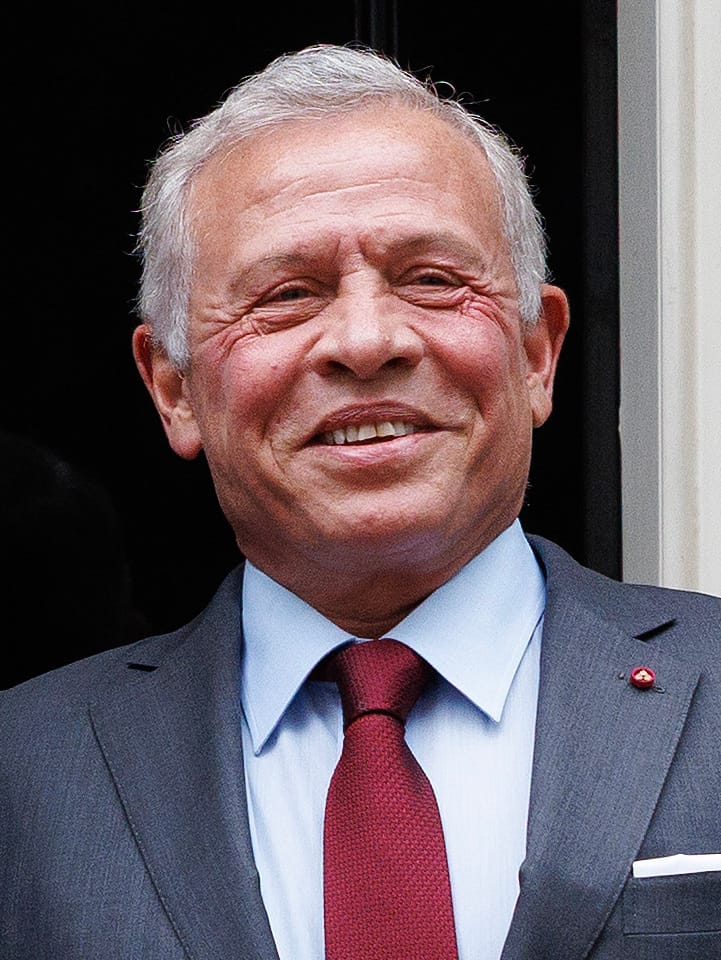
King Abdullah II — The Soldier King
Born January 30, 1962, Amman. The 41st direct descendant of the Prophet Muhammad (per rhc.jo — the official tiebreaker for all generation-count disputes). Education: Islamic Educational College Amman → Eaglebrook School and Deerfield Academy, Massachusetts → Royal Military Academy Sandhurst (commissioned 1981) → Pembroke College, Oxford (Middle Eastern Studies) → Georgetown University (MA International Relations, 1987).
Military career: served with British Army’s 13th/18th Royal Hussars; qualified as Cobra attack helicopter pilot, military freefall parachutist (HALO/HAHO), and combat diver; commanded Jordan’s Special Forces; reorganized them into the Special Operations Command (SOCOM) in 1996; promoted Major-General May 1998. Named Crown Prince January 24, 1999; became King February 7, 1999; coronation June 9, 1999; celebrated Silver Jubilee in 2024.
Notably: appeared uncredited as an extra on Star Trek: Voyager in 1995 — a lifelong Trekkie who seized the opportunity when filming in Los Angeles. When ISIS burned Jordanian pilot Muadh al-Kasasbeh alive in February 2015, Abdullah cut short a Washington trip, flew home, and Jordan executed two jihadist prisoners by dawn the next day.
Queen Rania Al Abdullah
Born Rania Al-Yassin, August 31, 1970, Kuwait City — to a Palestinian family originally from Tulkarm, West Bank. Her father was a paediatrician. After Iraq’s 1990 invasion of Kuwait, the family relocated to Jordan. She attended the American University in Cairo (AUC) — NOT the American University of Beirut, as often misreported — graduating 1991 with a Business Administration degree. Worked at Citibank then Apple in Amman. At a dinner party in January 1993 she met Prince Abdullah. They married June 10, 1993. She became Queen on February 7, 1999; proclaimed Queen by royal decree on March 22, 1999.
Among the first monarchs in the world to embrace social media — now over 10 million Instagram followers. World Economic Forum Board of Trustees; UNICEF Eminent Advocate for Children; founder of Jordan River Foundation (1995), Queen Rania Teacher Academy (2009), Queen Rania Foundation for Education and Development (2013), and Edraak (2014 — free Arabic-language MOOC platform serving millions). Consistently ranked among the world’s most stylish women.

The Controversies
🔴 The Pandora Papers (October 2021)
ICIJ revealed King Abdullah II had secretly assembled a luxury property portfolio worth over $106 million through at least 36 offshore shell companies in the British Virgin Islands. The portfolio included three beachfront mansions in Malibu (~$68m), luxury apartments in Washington D.C., and properties in London and Ascot — all while Jordan was running heavy budget deficits, requiring IMF austerity programmes, and hosting 1.3 million Syrian refugees on international aid. The Royal Hashemite Court denied wrongdoing, citing security and privacy.
🔴 The Prince Hamzah Crisis (April 2021)
On April 3, 2021, Jordanian intelligence units placed Prince Hamzah bin Hussein under house arrest on charges of plotting to destabilise the state with foreign backing. Former Royal Court Chief Bassem Awadallah and royal relative Sharif Hassan bin Zaid were arrested (they later received 15-year prison sentences). Hamzah smuggled a BBC video denying everything and accusing the government of corruption. King Abdullah publicly entrusted his uncle Prince Hassan to mediate the family crisis. A letter of family allegiance was signed. One year later — on April 3, 2022 — Hamzah renounced his title of Prince entirely. As of September 2026 he remains under house arrest. Queen Noor continues to call publicly for his release.
Crown Prince Hussein and Princess Rajwa: The Future King and His Saudi Bride
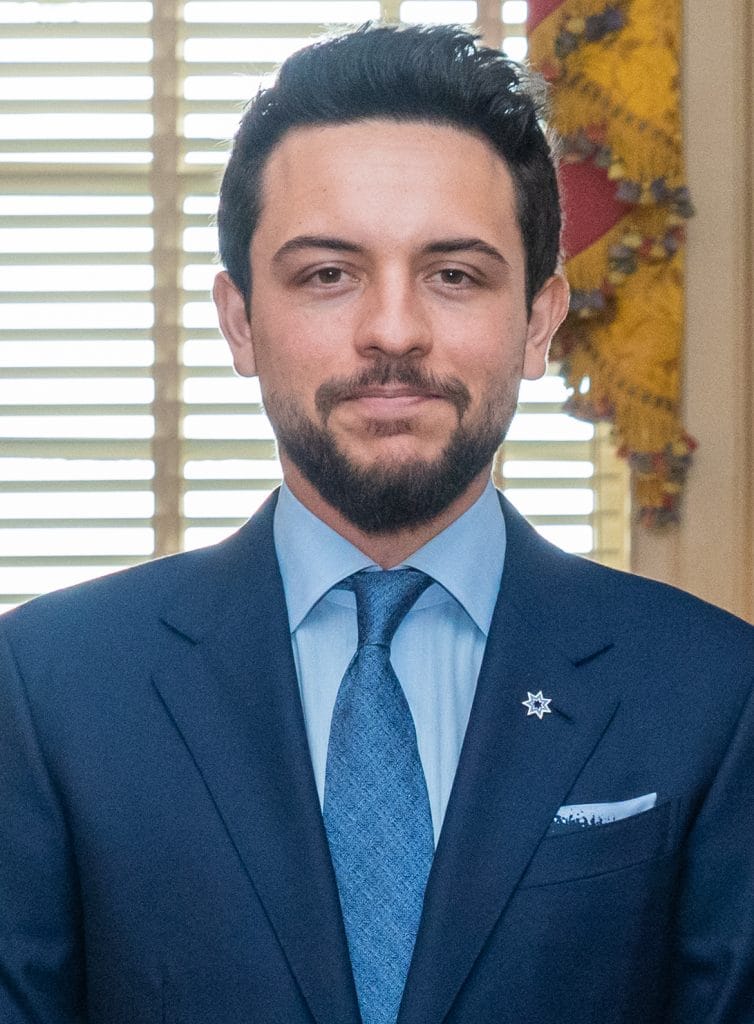
Born June 28, 1994, Amman. The 42nd direct descendant of the Prophet Muhammad. Named Crown Prince by royal decree on July 2, 2009 at age 15 (NOT at birth — a persistent error). Education: King’s Academy Madaba → Georgetown University (BA International History, 2016) → Royal Military Academy Sandhurst (August 2017). Currently a Major in the JAF; qualified military helicopter pilot.
At age 20, in April 2015, he became the youngest person in history to chair a UN Security Council session — contributing to UN Security Council Resolution 2250 (the landmark Youth, Peace and Security framework). Founded the Crown Prince Foundation (CPF) in 2015, now operating 26 locations across all 12 of Jordan’s governorates, including Al-Hussein Technical University and two 42-Network coding schools (42 Amman and 42 Irbid).
Princess Rajwa Al Hussein
Born Rajwa bint Khaled bin Musaed bin Saif bin Abdulaziz Al Saif, April 28, 1994, Riyadh — exactly 60 days before Crown Prince Hussein. Through her mother Azza bint Nayef Al Sudairi, she is a distant relative of King Salman of Saudi Arabia. Education: Bachelor of Architecture, Syracuse University (2017) + AA Visual Communications, FIDM Los Angeles (2019). Worked at PATTERNS Design in LA and Designlab Experience in Riyadh before her royal life began.
Engagement announced August 17, 2022 in Riyadh. Married June 1, 2023 at Zahran Palace in Amman. Her father Khaled Al Saif died in February 2024 — Jordan declared three official days of mourning. First child: Princess Iman bint Al Hussein, born August 3, 2024 at King Hussein Medical Center.
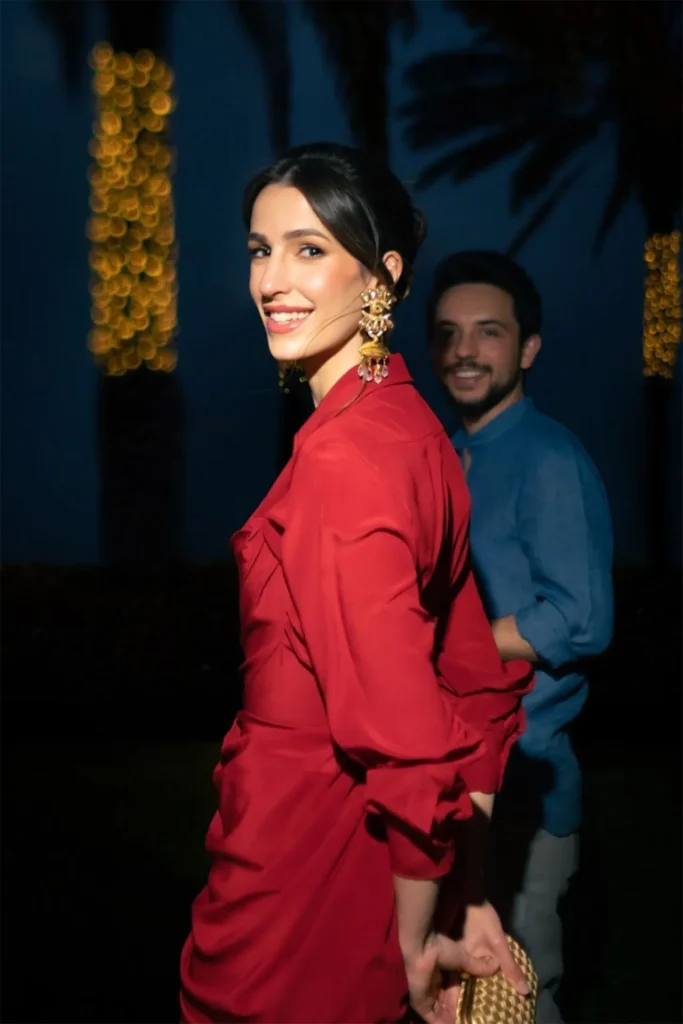
The June 1, 2023 Wedding — Key Facts
- Venue: Zahran Palace, Amman — same palace where King Hussein, then King Abdullah II, also married
- Rajwa’s arrival: Custom 1968 Rolls-Royce Phantom V
- Ceremony gown: Bespoke Elie Saab; tiara by FRED Jewellery Paris (designed by Yan Sicard)
- Banquet gown: Custom Dolce & Gabbana Alta Moda white ball gown with long white gloves
- Post-ceremony motorcade: Couple rode through 10km of Amman in a custom 1984 open-top Range Rover by Wood & Pickett
- Notable guests: Prince William and Princess of Wales; Dr. Jill Biden; King Willem-Alexander and Queen Máxima; Crown Prince Frederik and Crown Princess Mary of Denmark; Sultan of Brunei
- Common errors: Queen Letizia of Spain did NOT attend. Princess Anne did NOT attend.
Princess Iman bint Abdullah II and Jameel Thermiotis
Princess Iman bint Abdullah II was born September 27, 1996 — one day after her sister Princess Salma (September 26). She is the second child of King Abdullah II and Queen Rania. Education: Amman Baccalaureate School (2014, top female athlete) → Georgetown University → Parsons School of Design, New York (BBA Strategic Design and Management) — many sources still incorrectly report her as a Georgetown graduate; she is a Parsons graduate.
Her engagement to Jameel Alexander Thermiotis was announced on July 6, 2022 (the engagement ceremony was July 5, 2022) — this date was often misreported as a marriage announcement. The actual wedding took place on March 12, 2023 at Beit Al Urdun — the King and Queen’s private family residence in Amman (deliberately intimate, not a state palace). Approximately 150 guests attended.
Jameel’s birth name is Dimitrios Alexandros Thermiotis Hernández — born in Caracas, Venezuela, 1994, to a Greek father and Venezuelan mother. He converted to Islam and adopted the Arabic name “Jameel” (meaning beautiful) before the wedding. His paternal grandfather Dimitrios “Jimmy” Thermiotis (1922–2018) was born on the Greek island of Andros, emigrated to Venezuela, and represented Dior and major European luxury brands in Venezuela. The fact that Princess Iman wore a bespoke Christian Dior gown at their wedding — created by Maria Grazia Chiuri — is a remarkable poetic coincidence connecting both families’ histories. Her tiara was a diamond Chaumet piece that had belonged to Princess Muna al-Hussein and had never been seen publicly before that day. Jameel graduated from Florida International University (2015) and is a venture capital managing partner at Outbound Ventures LLC in New York.
Their children: daughter Amina (born February 16, 2025, at Prince Hashem bin Abdullah II Hospital in Aqaba); twins Talia and Rania (born August 14, 2026 — the birth was unannounced). Rania is named after her maternal grandmother, Queen Rania. Talia means “gentle dew from Heaven.” These are the 2nd, 3rd, and 4th grandchildren of King Abdullah II and Queen Rania.
Princess Salma bint Abdullah II: The Fighter Pilot Princess

Born September 26, 2000 — one day before sister Princess Iman. Education: Amman Baccalaureate School (2018) → Royal Military Academy Sandhurst (November 2018, age 18) → University of Southern California (BA Archaeology, May 12, 2023). At USC’s 2023 graduation, Sasha Obama was in the same class — King Abdullah was photographed conversing with Barack Obama.
On January 8, 2020, at a wings ceremony at Al Husseiniya Palace, her father King Abdullah II personally pinned her aviation wings. She became the first Jordanian woman to complete fixed-wing military pilot training — distinct from previous Jordanian women who had trained only on helicopters. In December 2023, she participated in an RJAF humanitarian airdrop to the Jordanian field hospital in northern Gaza — her most publicly documented operational mission.
In June 2021, she inaugurated NATO’s Military Women’s Training Centre in Ghabawi (Zarqa Governorate) — capacity 550 students/year, funded by Norway and Czech Republic under NATO Trust Fund III. Current rank: First Lieutenant, Royal Jordanian Air Force.
Fact-check note: Claims that Princess Salma shot down Iranian drones in April 2024 are entirely fabricated. The images used were from her December 2023 Gaza airdrop mission.
Prince Hashem bin Abdullah II: Regent at 18
Born January 30, 2005 — sharing his exact birthday with his father King Abdullah II (born January 30, 1962). The youngest of the four children. Second in the line of succession after Crown Prince Hussein. Graduated King’s Academy Madaba on May 24, 2023; currently studying at Georgetown University in Washington D.C. — making Georgetown a three-generation Hashemite tradition (King Abdullah II, Crown Prince Hussein, now Hashem).
His constitutional role as Regent is extraordinary: Jordan’s Constitution allows a male Hashemite of completed 18th lunar year to serve as Regent when both King and Crown Prince are simultaneously abroad. Hashem was sworn in before the Council of Ministers for his first Regency on August 14, 2023 (the King was in Egypt for a summit) at age 18. His second Regency was June 14, 2024 (King at the G7 Summit in Fasano, Italy). During Regency he exercises the King’s full constitutional powers: ratifying laws, issuing decrees, receiving ambassadors.
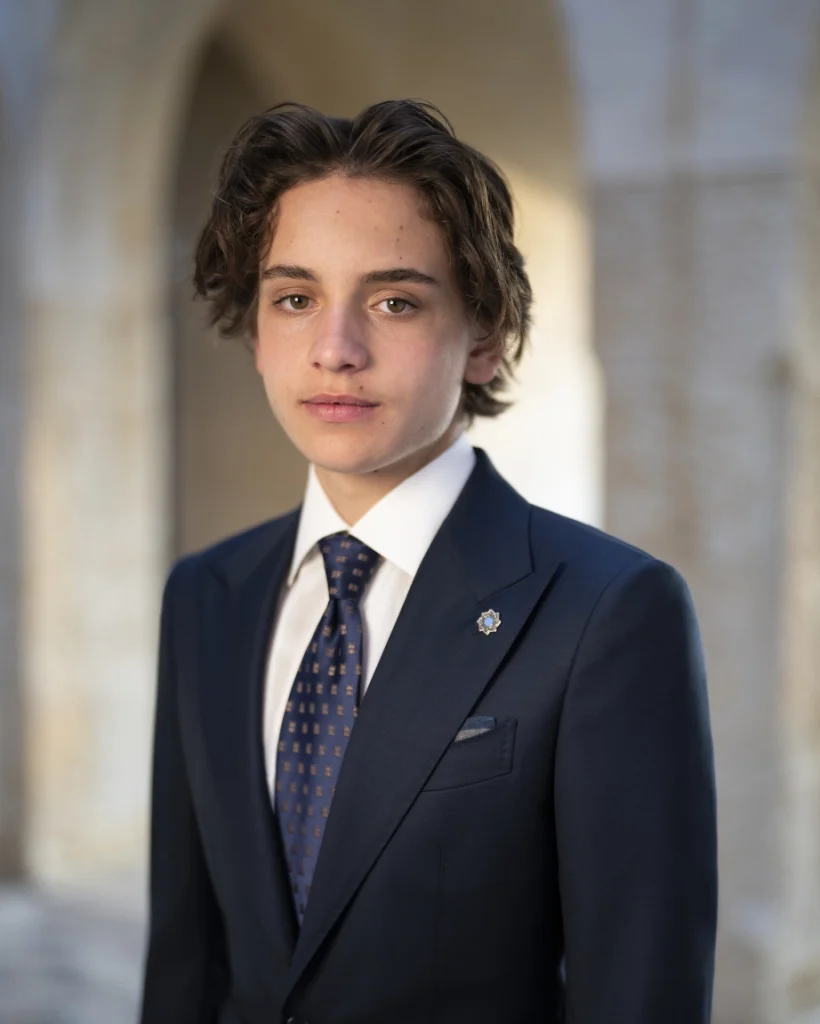
Princess Haya and the Dubai Court Scandal
In April 2019, Princess Haya bint Hussein — daughter of the late King Hussein and Queen Alia, Olympic equestrian (Sydney 2000), and former FEI President — fled Dubai with her two children. She had been married since 2004 to Sheikh Mohammed bin Rashid Al Maktoum, ruler of Dubai and Prime Minister of the UAE. She initially flew to Germany, then settled in the UK.
What followed was the most explosive royal divorce case in British legal history. UK High Court Family Division, presided by Sir Andrew McFarlane (President of the Family Division), delivered a series of findings that made global headlines:
- Abduction of Princess Shamsa: In July 2000, Shamsa (Sheikh Mohammed’s daughter by another wife) fled the family’s Surrey estate. In August 2000 she was snatched off the streets of Cambridge by agents working for her father, flown by helicopter to France, then by private jet to Dubai. She has not been seen publicly since.
- Abduction of Princess Latifa: Latifa attempted to escape by boat in 2018 from international waters off India. Indian commandos intercepted the vessel and forcibly returned her to Dubai. In 2021, secretly filmed video diaries surfaced in which she described being “a hostage in a converted villa.” The UN Human Rights Office demanded proof of life.
- Pegasus spyware: The court found Sheikh Mohammed had authorized the hacking of the phones of Princess Haya, her legal counsel (including Baroness Fiona Shackleton), and her associates using NSO Group’s Pegasus spyware. Sir Andrew McFarlane condemned this as a “serial breach of domestic criminal law.”
- Intimidation: A sustained campaign of coercive and controlling behaviour — including leaving loaded guns on Haya’s bed and publishing threatening poems.
The financial settlement — ordered by Mr Justice Moor in December 2021 — exceeded £554 million (approximately \$730 million): a £251.5m lump sum plus a £290m bank guarantee, explicitly designed to guarantee Haya’s and the children’s lifetime security given the “grave risk” posed by Sheikh Mohammed. In March 2022, Sir Andrew McFarlane awarded Haya sole custody of Princess Jalila (b.2007) and Sheikh Zayed (b.2012). Sheikh Mohammed has no face-to-face contact. As of 2026, Haya lives in a highly secured residence near Kensington Palace Gardens and an estate in Surrey.
Prince Ghazi bin Muhammad: The Scholar Who Changed Interfaith History
One of the most consequential and least-known members of the extended Hashemite family, Prince Ghazi bin Muhammad (born October 15, 1966) is the son of Prince Muhammad bin Talal and his first wife Firyal Irshaid. He graduated summa cum laude from Princeton University (BA Comparative Literature, 1988), then earned a PhD from Trinity College, Cambridge and a second PhD from Al-Azhar University in Cairo in Islamic philosophy. He serves as Chief Adviser for Religious and Cultural Affairs and Personal Envoy to King Abdullah II, and chairs the Royal Aal al-Bayt Institute for Islamic Thought.
His two landmark initiatives reshaped global Islam’s self-presentation to the world:
- The Amman Message (2004): Ghazi was the primary architect. The Message defined what constitutes a Muslim, explicitly forbade takfir (declaring other Muslims apostates — the ideological engine of sectarian violence), and regulated who can issue religious rulings. Endorsed by over 500 Islamic scholars globally. A direct theological counter to the ideology of groups like ISIS, years before ISIS existed.
- “A Common Word Between Us and You” (2007): An open letter signed by 138 Muslim scholars and clerics, addressed to Christian leaders worldwide, arguing that love of God and love of neighbour are the shared foundation of both faiths. Signed by the heads of every major Muslim denomination. Generated unprecedented global interfaith dialogue and formal responses from Pope Benedict XVI, the Archbishop of Canterbury, and dozens of Christian institutions. Widely regarded as the most significant Islamic-Christian dialogue initiative in modern history.
His books include Love in the Holy Qur’an, A Thinking Person’s Guide to Islam, and The Sacred Origin and Nature of Sports and Culture. His first marriage (1997–2020, divorced) to Areej Zawawi produced four children: Tasneem (b.1999), Abdullah (b.2001), Jennah (b.2003), and Salsabeel. On September 3, 2022, he married Míriam Ungría y López (now Princess Maryam Al Ghazi) — a Spanish gemologist and jewelry designer born in Madrid in 1963. She was previously the Dowager Princess of Tarnovo, having been married to Kardam, Prince of Tarnovo (eldest son of Tsar Simeon II of Bulgaria), who died in 2015 from injuries sustained in a car accident.
Prince Ali bin Hussein: The FIFA Challenger
Prince Ali bin Hussein (born December 23, 1975) — son of King Hussein and Queen Alia — is one of the most internationally active members of the family, not through diplomatic summitry but through football. Princeton-educated, he founded the West Asian Football Federation (WAFF) in 2000 and has served as its President ever since, unifying 12 national football federations across the region. He has served as Chairman of the Royal Film Commission Jordan since its founding in 2003, transforming Jordan (particularly Wadi Rum) into a major international film destination: Dune, Dune: Part Two, The Martian, Star Wars: Rogue One, The Rise of Skywalker, and Aladdin all shot there.
His two FIFA Presidential campaigns: in 2015 he challenged Sepp Blatter on a reform/transparency platform, receiving 73 votes to Blatter’s 133 in round one, then conceding. In the 2016 emergency congress, following Blatter’s resignation amid corruption scandals, Ali ran again — receiving just 4 votes as Gianni Infantino won with 115. He had publicly requested transparent voting booths to prevent voter intimidation; FIFA denied the request. In 2026, amid Jordan’s historic first-ever World Cup qualification, Ali publicly accused FIFA President Infantino of “blackmail and extortion” — alleging that FIFA delayed Jordan’s prize money payments and tied financial support to the Jordan Football Association to a political endorsement of Infantino’s re-election bid.
His wife Princess Rym Ali (née Rym Brahimi) was a CNN Baghdad correspondent from 2001 to 2003, when Iraqi intelligence expelled her for “biased reporting.” Her father, Lakhdar Brahimi, is one of the most significant diplomats of the 20th century: he mediated the Taif Agreement that ended the Lebanese Civil War, served as UN Special Envoy to Afghanistan (2001–04) during the post-Taliban reconstruction, UN Envoy to Iraq (2004), UN/Arab League Envoy for Syria (2012–14), and authored the landmark “Brahimi Report” on reforming UN peacekeeping operations. Princess Rym now serves as Executive Commissioner of the RFC and founder of the Jordan Media Institute (JMI). Children: Princess Jalila (b.2005) and Prince Abdullah (b.2007).
Prince Hamzah’s Full Family — 7 Children, Named at Last
Prince Hamzah bin Hussein (born March 29, 1980) — King Hussein’s reportedly favourite child, the son he named Crown Prince on his deathbed, and the man King Abdullah II quietly sidelined in 2004 and formally arrested in 2021. His house arrest is well-documented. His family is not. Here it is in full.
First Marriage: Princess Noor bint Asem (2003–2009, divorced)
Princess Noor bint Asem (born 1982) is the daughter of Prince Asem bin Nayef — from the Nayef branch covered earlier in this article. They married in 2003 and divorced in September 2009. No public explanation was given. They had one daughter: Princess Haya bint Hamzah (born April 18, 2007).
Second Marriage: Princess Basmah Bani Ahmad Al-Outom (2012–present)
Born 1979, raised in Ontario, Canada; attended the University of Western Ontario. Moved to Jordan in 2005 to study aviation at the Middle East Aviation Academy. She became the first female aerobatic pilot in the Arab world and chief pilot at the Royal Aero Sports Club of Jordan. A member of The Ninety-Nines, the international women pilots’ organization. They married in 2012. Their six children together:
- Princess Zein bint Hamzah (b. November 3, 2012)
- Princess Noor bint Hamzah (b. July 5, 2014)
- Princess Badiya bint Hamzah (b. April 8, 2016)
- Princess Nafisa bint Hamzah (b. February 7, 2018)
- Prince Hussein bin Hamzah (b. November 8, 2019)
- Prince Muhammad bin Hamzah (b. February 8, 2022)
Seven children total (one by first wife, six by second). Hamzah remains under house arrest as of September 2026, having renounced his Prince title in April 2022. Princess Basmah and the children remain under restrictions, though schooling restrictions have reportedly eased slightly. Queen Noor continues publicly demanding his release.
Who Is Who: Navigating the Repeated Names
The Hashemite family has a habit of using the same names across generations — which creates serious confusion. Here is the definitive disambiguation table:
THREE women named “Iman”:
- Princess Iman bint Abdullah II (b.1996) — King Abdullah’s daughter; married Jameel Thermiotis; has 3 daughters (Amina, Talia, Rania)
- Princess Iman bint Hussein (b.1983) — Queen Noor’s daughter; divorced Zaid Mirza 2017; has son Omar
- Princess Iman bint Al Hussein (b.August 2024) — Crown Prince Hussein’s baby daughter with Princess Rajwa
TWO men named “Hashem/Hashim”:
- Prince Hashem bin Abdullah II (b.2005) — King Abdullah’s youngest son; the current Regent; studying at Georgetown
- Prince Hashim bin Hussein (b.1981) — Queen Noor’s son; military career; married Fahdah Abunayyan; five children
TWO women named “Haya”:
- Princess Haya bint Hussein (b.1974) — fled Dubai 2019; £554m court settlement; lives in London
- Princess Haya bint Hamzah (b.2007) — Prince Hamzah’s daughter by his first wife
TWO women named “Zein”:
- Princess Zein bint Hussein (b.1968, twin of Aisha) — King Hussein’s daughter; married Majdi Al-Saleh
- Princess Zein bint Hamzah (b.2012) — Prince Hamzah’s eldest daughter by second wife Basmah
Frequently Asked Questions
Who is next in line to the Jordanian throne after Crown Prince Hussein?
Prince Hashem bin Abdullah II (b.2005) is second in line. Jordan’s Constitution Article 28 mandates strictly male-line succession. No female descendant — neither Princess Iman, Princess Salma, nor any of the grandchildren — can inherit the throne under the current constitution. There is no current reform effort underway.
Is Princess Rajwa related to the Saudi royal family?
Yes, distantly. Through her mother Azza bint Nayef Al Sudairi, Princess Rajwa comes from the Al Sudairi lineage historically linked to King Salman’s family. She is a distant relative of King Salman. Her father Khaled Al Saif was a prominent businessman, not a member of the ruling Al Saud family itself.
How many grandchildren does King Abdullah II have as of 2026?
Four: Princess Iman bint Al Hussein (b.August 3, 2024 — Crown Prince Hussein’s daughter), Amina (b.February 16, 2025 — Princess Iman bint Abdullah’s daughter), and twins Talia and Rania (b.August 14, 2026 — Princess Iman bint Abdullah’s twin daughters). Only Princess Iman bint Al Hussein carries an HRH title, as a King’s son’s daughter under Hashemite succession rules.
What is the correct generation count for the Hashemite royal family?
Per the Royal Hashemite Court (rhc.jo) — the definitive source: King Abdullah II is the 41st direct descendant of the Prophet Muhammad. His son Crown Prince Hussein is the 42nd. Many sources still circulate the outdated “43rd” figure from a 1999 commemorative website published when Hussein died — that figure was revised when the Court standardised the official genealogical register. The RHC figure is the tiebreaker for all disputes.
Was Crown Prince Hussein appointed at age 2?
No. Crown Prince Hussein was formally designated heir by royal decree on July 2, 2009, at age 15. Between 1999 and 2004 his uncle Prince Hamzah held the title. After Hamzah’s title was removed in November 2004, the position remained vacant until 2009. The “age 2” claim is one of the most widespread errors in coverage of this family.
Primary sources: Royal Hashemite Court (rhc.jo), kingabdullah.jo, alhussein.jo, queenrania.jo, Jordan Times, Arab News, The National, Petra (Jordan News Agency), UK High Court Family Division judgments, ICIJ (Pandora Papers), Newsweek (2018 CIA memo report), LA Times (1989 trial coverage), Harper’s Bazaar Arabia, Hello Magazine, Unofficial Royalty. All dates cross-referenced against official court records. Last updated September 2026.