
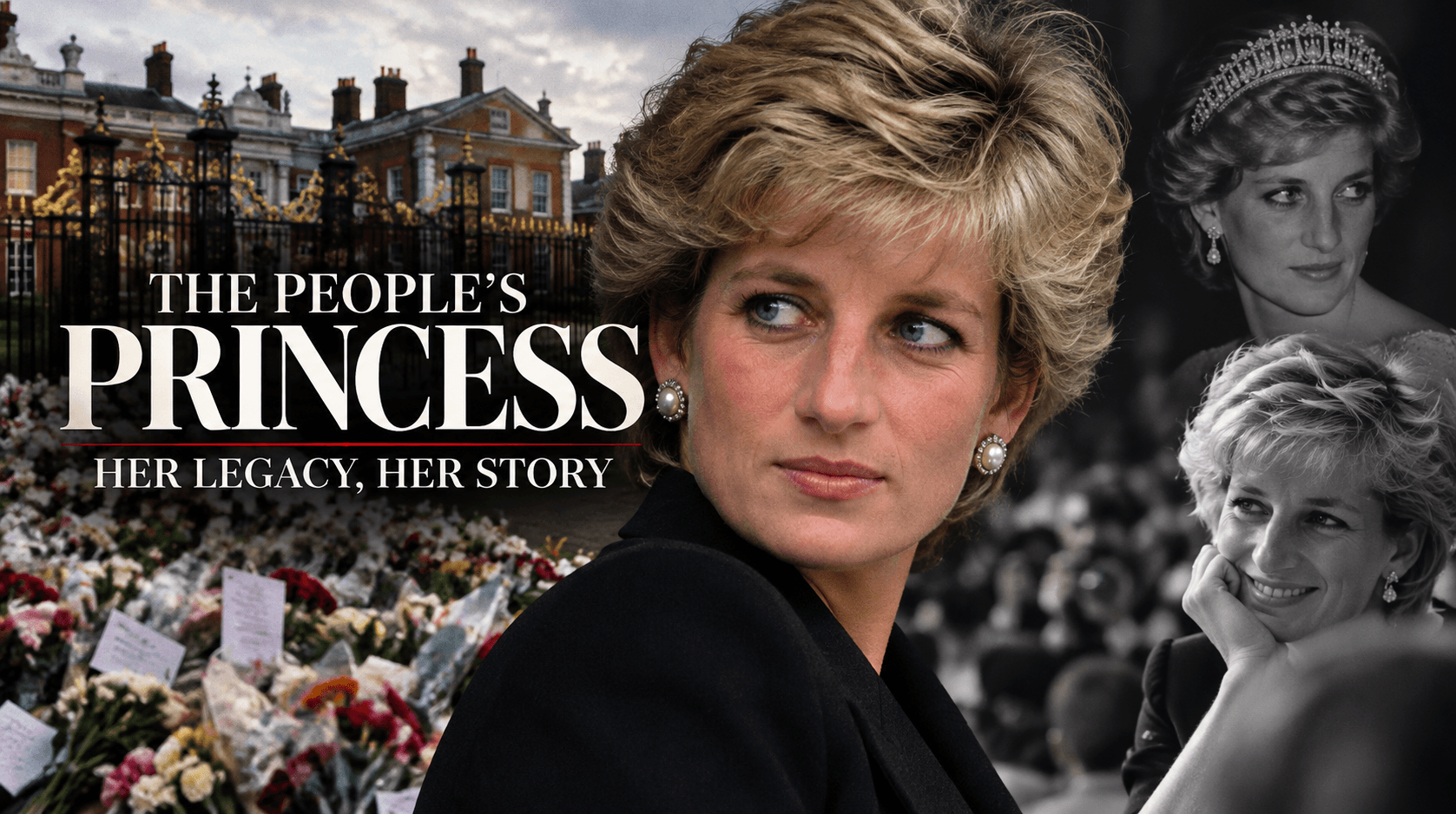
Diana: The People’s Princess — The Definitive Biography
She was the most hunted person of the modern age. A woman born into centuries of aristocratic privilege who, paradoxically, became the most relatable, emotionally resonant figure of the twentieth century. Diana, Princess of Wales, rewrote the rulebook of the British monarchy, revolutionized global humanitarianism, and died in a tragedy that brought the world to a standstill.
This is the definitive account of her life—a documented, comprehensive investigation into the woman who transformed from a shy nursery assistant into the Queen of People’s Hearts.
The Spencer Bloodline
She was born Diana Frances Spencer on July 1, 1961, at Park House on the Sandringham estate—a property her family leased directly from the Crown. Her arrival, however, was overshadowed by grief. Just eighteen months earlier, in January 1960, her parents had lost a baby boy, John, who died mere hours after birth. As the third daughter in a family desperate for an heir, Diana’s birth was widely seen as a disappointment.
Yet, her bloodline was formidable. The Spencer family had resided at the sprawling Althorp estate since 1508. Ironically, Diana possessed more English royal blood than the Windsors themselves. She was descended from Barbara Villiers, the notorious mistress of King Charles II, and her lineage directly connected her to Winston Churchill, the Duke of Marlborough, and Britain’s first Prime Minister, Robert Walpole. She was aristocratic royalty long before she ever met a prince.
Childhood Behind Aristocratic Gates
Diana’s parents, John Spencer (the 8th Earl Spencer) and Frances Roche, provided a life of immense material wealth, but emotional bankruptcy. She was raised alongside her older sisters, Sarah (born 1955) and Jane (born 1957), and her younger brother, Charles (born 1964), who finally provided the required male heir.
The family fractured in 1967 when Diana was just six years old. Frances left her husband for the wallpaper heir Peter Shand Kydd. What followed was a vicious 1969 custody battle that produced one of the most shocking betrayals in the family’s history: Ruth, Lady Fermoy—Diana’s own maternal grandmother—testified against her own daughter, Frances, in court. This betrayal helped John Spencer win full custody of the children.
The trauma of this separation became the central psychological wound of Diana’s life. She would later vividly recall sitting on the doorstep of Park House, waiting for a mother who would not return. Biographers cite this formative abandonment as the root of her lifelong need for love, validation, and her extraordinary capacity for empathy with other suffering people.
Complicating the family dynamic further, John Spencer secretly married Raine Spencer (formerly Countess of Dartmouth and daughter of the novelist Barbara Cartland) in 1976. The Spencer children despised her, branding her “Acid Raine.” She sold off over 200 family heirlooms from Althorp to fund extensive renovations. Diana’s brother Charles Spencer likened the result to a “wedding cake vulgarity.” The animosity reached a physical peak when Diana reportedly pushed Raine down a staircase in 1989. Remarkably, Diana later reconciled with Raine after her own divorce, finding in her an unlikely confidante who understood what it meant to be an outsider in an aristocratic world.
Meanwhile, Ruth, Lady Fermoy—the same grandmother who had testified against Frances—was a Woman of the Bedchamber to the Queen Mother and a crucial figure in Diana’s path toward the palace. Their relationship grew deeply estranged as Diana’s marriage collapsed, with Fermoy’s fierce loyalty to the Crown overriding her blood ties. She died in 1993.
From Nursery Teacher to Future Queen
Diana’s education was quintessentially aristocratic but academically unremarkable. She attended Riddlesworth Hall (1970-1973) in Norfolk, then West Heath in Sevenoaks (1973-1977), where she notoriously failed her O-levels twice but won an award for community spirit. A brief finishing school stint at the Institut Alpin Videmanette in Switzerland in early 1978 lasted barely one term.
Returning to London, she moved into a flat at 60 Coleherne Court on Old Brompton Road with friends Carolyn Bartholomew, Virginia Clarke, and Anne Bolton—labeling herself “Chief Chick” with a sign on her bedroom door and charging each flatmate £18 per week. She took on ordinary jobs: a cleaner for her sister Sarah; a nanny for an American family, the Robertsons, earning just $5 an hour; and, most famously, a nursery assistant at the Young England Kindergarten in Pimlico.
The Courtship
Diana first met Prince Charles in November 1977 at Althorp, when he arrived for a grouse shoot. He was 29 and was at the time dating her older sister Sarah. Diana, just 16, later described herself in the Morton tapes as a “fat, podgy, no make-up, unsmart lady” who nevertheless made “a lot of noise”—and who found it astonishing that “someone like that” paid her any attention.
Their romance did not ignite until the summer of 1980, when she was invited to Balmoral. On September 8, 1980, the Sunday Mirror broke the first press story. From that point, Diana’s life was never private again. The infamous September 17 photograph at the Young England Kindergarten—where bright backlighting rendered her white skirt transparent—propelled her instantly into the global spotlight. Behind palace doors, Prince Philip wrote a stern letter to Charles, urging him to propose to Diana or release her.
The Engagement: ‘Whatever Love Means’
On February 6, 1981, in the nursery at Windsor Castle, Charles proposed. Having met him only about thirteen times, Diana initially laughed, thinking it was a joke. She harbored serious doubts about Camilla Parker Bowles’s continued presence in his life—but said yes. The engagement was officially announced on February 24, 1981.
During their engagement interview, when asked if they were in love, Diana quickly replied “Of course,” but Charles added a devastating caveat that would echo for decades: “Whatever love means.” Diana later described this moment as “traumatizing.”
She wore an off-the-rack cobalt blue Cojana suit purchased at Harrods. Her engagement ring, however, made global history: a 12-carat oval Ceylon sapphire surrounded by 14 solitaire diamonds, set in 18-carat white gold by the Crown Jewellers, Garrard. Controversially, it was not a custom commission—it was selected from a catalog, meaning anyone with £28,000 could have bought the same ring. Today the ring is estimated to be worth between £300,000 and £400,000. In November 2010, Prince William used the same ring to propose to Kate Middleton.
The engagement period was a crisis in the making. Moving first to Clarence House, then Buckingham Palace, Diana found herself profoundly isolated. During this period, Charles allegedly made an offhand comment about her waistline. That remark triggered the onset of bulimia nervosa—an illness that would ravage her for more than a decade.
The Wedding of the Century
On July 29, 1981, the world stopped. St Paul’s Cathedral was chosen over Westminster Abbey because its 3,500-seat capacity dwarfed the Abbey’s 2,000, and it allowed for a longer, more spectacular carriage procession route. Archbishop of Canterbury Robert Runcie began the ceremony at 11:20 AM.
Diana’s gown, designed by David and Elizabeth Emanuel, became an instant legend. Made of ivory silk taffeta and antique Carrickmacross lace from Queen Mary’s collection—her “something old”—it featured the longest train in royal wedding history at 25 feet, and a 153-yard tulle veil. She wore the Spencer Family Tiara and low-heeled Clive Shilton shoes, the suede soles painted with a “C and D” wrapped in a heart. Hidden inside the waistband was a small blue bow and a gold horseshoe studded with diamonds for luck. The dress severely crumpled on the way to the cathedral because the glass carriage was too small for Diana, the voluminous gown, and her father.
In front of an estimated 750 million television viewers and 600,000 people lining the streets, a nervous Diana flubbed her vows, calling her groom “Philip Charles Arthur George” instead of “Charles Philip Arthur George.”
The honeymoon told a different story. At Broadlands, then aboard the Royal Yacht Britannia in the Mediterranean, and finally at Balmoral, Diana cried constantly. Her bulimia worsened dramatically. A defining detail from the Morton tapes: Charles wore cufflinks bearing interlinked “C”s—a gift from Camilla Parker Bowles—throughout the honeymoon.
Life Inside the Monarchy
The facade of the fairy tale cracked almost immediately. Queen Elizabeth II maintained a studied emotional detachment, preferring that marital difficulties be resolved privately. Prince Philip took a more interventionist approach, writing letters to Charles in which he reportedly called his son “foolish” for risking everything for Camilla.
Behind her public duties—the state visits, the hospital openings, the school visits—Diana was fighting her own private war. Her bulimia, by her own account, reached four to five purging episodes a day. She engaged in self-harm, and in one documented account, threw herself down a staircase at Sandringham while pregnant with Prince William.
The tension boiled over in 1989 at a party hosted by Lady Annabel Goldsmith. Diana approached Camilla Parker Bowles directly, stating, “I know what’s going on between you and Charles and I just want you to know that.” When Camilla asked what more Diana could possibly want, Diana replied quietly but devastatingly: “I want my husband.”
The reality of Charles’s relationship with Camilla was brutally confirmed by the leaked “Camillagate” tape, recorded on December 18, 1989, and published in The Sun in January 1993. The sexually explicit transcript featured the heir to the throne famously joking about being reincarnated as a Tampax.
The Humanitarian Princess
Where her personal life was failing, her public duty became her salvation. Diana leveraged the most intense media scrutiny of any living person to illuminate the world’s darkest corners. She became patron of over 100 charities, including the Great Ormond Street Hospital for Children (serving as President from 1989 to 1997), Centrepoint, the Leprosy Mission, the English National Ballet, Relate, the British Lung Foundation, and the National AIDS Trust.
She introduced William and Harry to the realities of poverty by taking them on private night visits to homelessness shelters. In a landmark 1993 speech at an eating disorders conference, she reframed conditions like bulimia not as vanity or weakness, but as expressions of profound emotional pain—a decade before mental health became a mainstream conversation.
The AIDS Handshake That Changed the World
On April 9, 1987, at Middlesex Hospital, Diana performed a simple act that changed medical and social history. She opened the UK’s first purpose-built HIV/AIDS ward, then—without wearing gloves—shook the hand of a patient later identified as Ivan Cohen, who requested to be photographed only from behind to protect his privacy.
In 1987, public fear and medical misinformation about HIV/AIDS were rampant. Many believed the virus could spread through casual contact. Diana’s barehanded gesture, broadcast globally, shattered that stigma. She subsequently became patron of the National AIDS Trust in 1989 and made frequent private visits to the London Lighthouse hospice, where she sat with dying men the world had abandoned.
The Landmine Crusade
In the final year of her life, Diana took on the global arms trade itself. Between January 13 and 16, 1997, she traveled to Angola with the HALO Trust. On January 15, she walked through an active minefield in the Huambo region, wearing a ballistic vest and visor. Her HALO Trust escort, Paul Heslop, later joked that he had not wanted to go down in history as “the man who blew up the Princess.” When Conservative defence minister Earl Howe publicly called her a “loose cannon” for interfering in military policy, Diana replied with characteristic steadiness: “I’m only trying to highlight a problem that’s going on all around the world, that’s all.”
Her crusade continued at an American Red Cross gala in Washington D.C. on June 16-17, and reached its final chapter with her last overseas tour: Bosnia (Sarajevo, Zenica, and Dobrnja) from August 8-10, 1997—just three weeks before her death.
Her impact was historic. The Ottawa Treaty, banning anti-personnel landmines globally, was signed on December 3, 1997, three months after her death. The International Campaign to Ban Landmines (ICBL) won the Nobel Peace Prize that same year. Organizers credited Diana’s global platform with accelerating the treaty’s passage.
Her spiritual kinship with compassion was embodied in her relationship with Mother Teresa. After missing a planned meeting in Calcutta in February 1992 (Mother Teresa was ill in Rome), they met at a Roman convent weeks later. Mother Teresa called Diana “my daughter.” Their final meeting was in New York in June 1997. With eerie symmetry, Mother Teresa died on September 5, 1997—just five days after Diana. Diana was buried holding a set of rosary beads given to her by the saint.
The Fashion That Told a Story
Diana communicated with the world through clothes. Her wardrobe was simultaneously a shield, a weapon, and a diary. From her first public appearance after the engagement—the black strapless Emanuel gown at Goldsmiths’ Hall on March 9, 1981, which reportedly horrified the Queen Mother but announced her arrival as a global fashion force—to her final documented outfit (a dark navy blazer and cream trousers, caught on the Paris Ritz’s CCTV cameras in the early hours of August 31, 1997), every garment told a chapter of the story.
- The Sheep Sweater (June 1981): At Guards Polo Club, Windsor, she wore a white Warm & Wonderful knit by Sally Muir and Joanna Osborne—rows of white sheep punctuated by a single red sheep. Widely interpreted as self-identification as the royal “black sheep,” she later snagged the original on her ring and wore a replacement in 1983. The original was rediscovered and sold at Sotheby’s in 2023 for $1.14 million. Modern replicas remain available via Rowing Blazers x Warm & Wonderful (~$248-$295).
- The Victor Edelstein ‘Travolta Dress’ (November 9, 1985): At a White House State Banquet hosted by President Reagan, Diana wore a midnight blue velvet off-the-shoulder gown. Nancy Reagan orchestrated a dance with John Travolta. The gown sold at Christie’s in 1997 for $222,500. It sold again in 2019 for £264,000 to Historic Royal Palaces and now forms part of the Royal Ceremonial Dress Collection at Kensington Palace.
- Catherine Walker’s ‘Elvis Dress’ (Hong Kong, 1989): A white silk strapless column gown with a pearl-and-sequin encrusted bolero jacket. Diana named it “Elvis” because the high collar reminded her of the King of Rock and Roll. Walker—French-born, London-based—created over 1,000 outfits for Diana across 15 years. She died of breast cancer in September 2010. Diana was buried in one of Walker’s black dresses.
- The Christie’s Auction (June 25, 1997): Diana auctioned 79 of her most iconic gowns at Christie’s New York. Photographed for the catalog by Patrick Demarchelier (Diana signed 250 limited-edition copies), the sale raised approximately $3.25 million for the AIDS Crisis Trust and the Royal Marsden Hospital Cancer Fund.
The Revenge Dress — A Full Investigation
On June 29, 1994, Prince Charles went on national television and publicly admitted his adultery to journalist Jonathan Dimbleby. That same evening, Diana stepped out of a car at the Serpentine Gallery’s summer party—hosted by Lord Palumbo—and detonated a fashion explosion that would be analyzed for decades.
She wore a short, body-hugging, off-the-shoulder black silk dress by Christina Stambolian, a Greek-born, London-based designer. Diana had owned the dress for approximately three years but had always deemed it “too daring.” When her original Valentino gown was leaked to the press before the event, she pivoted decisively to the Stambolian piece, pairing it with the Queen Mother’s extraordinary sapphire, diamond, and multi-strand pearl choker.
The media coined the phrase “Revenge Dress.” Diana never used the term. But its meaning was unmistakable: while the nation was watching Charles’s confession, Diana was reminding the world exactly who it loved. The dress sold at Christie’s in 1997 for $74,000 and remains in a private collection.
The Marriage Unravels
The marriage collapsed publicly in stages. In June 1992, the bombshell struck with the publication of Andrew Morton’s book, Diana: Her True Story. The book had been made in secret: Diana recorded her answers to Morton’s questions alone at Kensington Palace, and the tapes were smuggled out by bicycle by her friend Dr. James Colthurst acting as intermediary. The book exposed Charles’s affair with Camilla, Diana’s bulimia, her suicide attempts, and the emotional devastation behind the fairy tale.
Further humiliation came in August 1992 when The Sun published the “Squidgygate” tapes—a recorded telephone call from December 31, 1989, between Diana and her friend James Gilbey, who called her “Squidgy” an astonishing fourteen times. Gilbey’s intimate conversation became public fodder. The marriage was publicly finished. On December 9, 1992, Prime Minister John Major announced the formal separation before the House of Commons.
Between 1993 and 1994, Diana became entangled in another damaging episode: hundreds of silent phone calls to the home of married art dealer Oliver Hoare were traced by police to Diana’s private lines at Kensington Palace. She denied making them. No criminal action followed, but the episode damaged her public image.
The Panorama Interview and the BBC Scandal
On November 20, 1995, an astonishing 22.8 million UK viewers tuned into BBC Panorama to watch Diana deliver a masterclass in public warfare. Filmed secretly at Kensington Palace by journalist Martin Bashir, Diana—wearing dark kohl eyeliner and a somber suit—spoke directly to the nation in a way no royal had ever done.
The key quotes that entered history:
- “There were three of us in this marriage, so it was a bit crowded.”
- On Charles as King: “The top job…would bring enormous limitations to him, and I don’t know whether he could adapt to that.”
- On her aspirations: “I’d like to be a queen of people’s hearts, in people’s hearts.”
- On James Hewitt: “Yes, I adored him. Yes, I was in love with him. But I was very let down.”
- On postnatal depression: “You’d wake up in the morning feeling you didn’t want to get out of bed, you felt misunderstood, and just very, very low in yourself.”
On December 20, 1995, an unprecedented step: Queen Elizabeth wrote to both Charles and Diana, urging them to divorce immediately.
Twenty-six years later, the true story of how Bashir obtained the interview was exposed. The May 2021 Dyson Report—conducted by Lord Justice Dyson—found that Bashir had used “deceitful behaviour” to secure it. He had commissioned BBC graphic designer Matt Wiessler to create forged bank statements, which Bashir showed to Earl Spencer to convince him that Diana’s own security personnel—including her Private Secretary, Patrick Jephson—were being paid to spy on her. Jephson was manipulated out of his job as a result. The BBC had covered up its own 1996 internal investigation, under Director-General John Birt.
Prince William’s statement called the interview’s legitimacy into question: “The deceitful way the interview was obtained substantially influenced what my mother said.” Prince Harry stated that “a culture of exploitation and unethical practices ultimately took her life.” Earl Spencer expressed “eternal regret” for having introduced Bashir to his sister. Bashir resigned from the BBC in May 2021 citing health reasons. He has not returned to journalism.
The Divorce (1996)
The marriage was legally terminated on August 28, 1996. The financial settlement provided Diana with an estimated £17 million lump sum, plus an annual allowance of approximately £350,000-£400,000. Most painfully, at Charles’s insistence, she was stripped of the style “Her Royal Highness,” becoming simply “Diana, Princess of Wales.” She retained her apartments at Kensington Palace. Though wounded by the loss of the HRH title, the divorce gave her something she had never truly had: freedom.
The Men in Her Life
Diana’s private life was a chronicle of longing and disappointment. Her first serious documented attachment was to Barry Mannakee, a Royal Protection Officer assigned to her in 1985. She spoke of him in private tapes as her “greatest love.” He was removed from her detail in 1986 and died in a motorcycle accident on May 15, 1987. Three official investigations found no evidence of conspiracy.
Her affair with former Household Cavalry officer James Hewitt lasted from approximately 1986 to 1991. She confirmed it plainly in the Panorama interview. Anna Pasternak’s 1994 book Princess in Love, written with Hewitt’s cooperation, detailed the relationship. The persistent myth that Hewitt is Prince Harry’s biological father is biologically impossible: Harry was born on September 15, 1984—two years before Diana reportedly first met Hewitt. Hewitt himself denied the claim in 2002: “There really is no possibility whatsoever that I am Harry’s father.”
The most serious love of Diana’s life, according to biographers and inquest testimony, was Dr. Hasnat Khan, a Pakistani-British cardiac surgeon at London’s Royal Brompton Hospital. They met in September 1995, when Diana visited the hospital with her spiritual healer to see a patient. They maintained an intensely private relationship—Diana reportedly visited his flat in disguise—until the summer of 1997, when Khan, unable to endure the media scrutiny, ended the relationship. At the 2008 inquest, Khan testified that Diana had no intention of marrying Dodi Fayed and that she was meticulous about contraception.
The Last Summer: Dodi and Paris
In July 1997, Diana accepted an invitation from Harrods owner Mohamed Al-Fayed to vacation in Saint-Tropez on his 195-foot yacht, the Jonikal, with William and Harry. There she grew close to his son, Dodi Fayed, a film producer whose credits included the Oscar-winning Chariots of Fire (1981) and Flatliners (1990). The summer romance became global news when Italian paparazzo Mario Brenna’s “The Kiss” photographs were published in the Sunday Mirror on August 10, reportedly for a figure in the millions.
The relationship was not without complications. On August 14, Dodi’s concurrent American fiancée, model Kelly Fisher—represented by attorney Gloria Allred—held a press conference announcing a breach-of-contract lawsuit against him. Diana appeared either unaware or unconcerned.
Between August 15 and 20, Diana holidayed with her close friend Rosa Monckton in the Greek islands—without Dodi. During this trip, Diana had her menstrual period. This biological fact, confirmed by Rosa Monckton under oath at the 2008 inquest, conclusively refuted the later conspiracy theory that Diana died pregnant with Dodi’s child.
After a final Sardinian cruise from August 25-30, Diana spoke by phone to Daily Mail correspondent and friend Richard Kay on the afternoon of August 30. She was, by his account, “in a good place”—planning to withdraw from formal public duties, eager to see her sons, and exploring the possibility of establishing a worldwide hospice network. She made no mention of an impending engagement. Meanwhile, Dodi had purchased a “Dis-moi Oui” (Tell Me Yes) ring from the Repossi jeweller in Monte Carlo. There is no evidence Diana had accepted—or was even aware—that a proposal was imminent.
August 30-31, 1997: The Last Night
Diana and Dodi flew into Le Bourget airport at approximately 3:20 PM on August 30. They visited the Villa Windsor in the Bois de Boulogne—a property Mohamed Al-Fayed was renovating—before arriving at his Ritz Hotel at approximately 9:50 PM. Besieged by aggressive paparazzi at the hotel’s front, they attempted to dine at the Ritz’s L’Espadon restaurant but retreated quickly to the Imperial Suite for privacy.
Shortly after midnight, a plan was hatched: they would sneak out the hotel’s rear entrance while decoy vehicles drew the paparazzi to the front. It failed. Several photographers had already positioned themselves at the rear. The Mercedes S280, driven by the Ritz’s acting Head of Security, Henri Paul, departed at approximately 12:20 AM on August 31, heading for Dodi’s apartment on Rue Arsène Houssaye.
What neither Diana nor Dodi knew was that Henri Paul had spent the early evening hours drinking at local bars. Blood tests would later confirm a blood alcohol concentration of 1.74-1.80 g/L—more than three times the French legal limit of 0.50 g/L—combined with prescription Fluoxetine (Prozac) and Tiapride, a combination dramatically impairing motor skills and judgment.
The Crash: What the Evidence Shows
At 12:23 AM, entering the Pont de l’Alma underpass at an estimated 90-105 km/h—double the 50 km/h speed limit—the Mercedes clipped a white Fiat Uno and slammed into the tunnel’s 13th concrete support pillar. Dodi Fayed and Henri Paul died at the scene. Bodyguard Trevor Rees-Jones—the only occupant wearing a seatbelt—survived with catastrophic facial injuries requiring over 150 titanium pieces to reconstruct his face. He suffered permanent retrograde amnesia about the crash.
An off-duty physician, Dr. Frédéric Mailliez, happened to be driving in the opposite direction and stopped within a minute to provide first aid, not yet recognizing his patient. French SAMU emergency services followed the “stay and stabilize” protocol, spending approximately 40 minutes at the scene before beginning the slow drive to Pitié-Salpêtrière Hospital. Medical experts at the 2008 inquest testified that Diana had suffered a tear in her left pulmonary vein causing catastrophic internal hemorrhage—injuries that were likely unsurvivable regardless of the speed of transport. She was pronounced dead at 4:00 AM.
She died estranged from her mother, Frances Shand Kydd—who had been returning Diana’s letters unopened for the last four months of her life. Her final telephone call with William and Harry had been rushed. Both princes have spoken of their enduring regret at how quickly they ended that last conversation.
The Conspiracy Theories: Examined and Evidenced
Three exhaustive official investigations examined every conspiracy theory: the 1999 French inquiry by Judge Hervé Stéphan; the 2006 British Operation Paget (832 pages, led by Lord Stevens); and the 2007-2008 British Inquest under Lord Justice Scott Baker. Their collective verdict was unambiguous: the crash was an accident caused by a drunk, speeding driver and a reckless pursuit by paparazzi.
- MI6 ordered the killing: Former MI6 officer Richard Tomlinson alleged that a 1992 draft plan to assassinate a Balkan leader (using a blinding strobe in a tunnel) served as a template for Diana’s murder. Operation Paget confirmed the 1992 draft plan existed but had been immediately killed by management and never implemented. No evidence linked British intelligence to the Paris crash.
- Henri Paul was an intelligence asset: Paul was confirmed as a low-level, occasional informant for the French DST—standard practice for the security chief of one of Paris’s most prominent hotels. His bank accounts held approximately 1.7 million Francs, allegedly suspicious. Operation Paget traced every deposit: legitimate cash tips accumulated from wealthy Ritz guests over many years. His blood was DNA-confirmed as his own, ruling out sample tampering.
- The white Fiat Uno was a hit vehicle: A white Fiat Uno did collide with the Mercedes before the crash—paint transfer confirmed this. British investigators identified Le Van Thanh, a French security guard who repainted his car red hours after the crash and repeatedly refused to cooperate with UK inquiries. The collision was assessed as an accidental hit-and-run, not a targeted strike.
- Diana was pregnant: Medically disproven. Blood recovered from the car floor mats tested negative for hCG (the pregnancy hormone). Rosa Monckton confirmed Diana menstruated days before the crash. Hasnat Khan testified Diana was meticulous about contraception. The post-mortem embalming (criticized by conspiracy theorists as a cover-up) was a standard procedure in a hot, non-refrigerated room to preserve the body before repatriation.
- Diana’s note predicting her death: Paul Burrell revealed in 2003 a handwritten note in which Diana described fearing “an accident in my car, brake failure and serious head injury.” Operation Paget authenticated the handwriting. However, the actual crash involved neither brake failure nor any of the elements Diana described—it was caused by an intoxicated driver. Burrell later admitted under oath he had found the note propped on his desk, not watched Diana write it, damaging his earlier claims.
- A flash of light blinded Henri Paul: A witness, François Levistre, claimed to have seen a blinding white flash in the tunnel. He was severely discredited at the 2008 inquest, with his testimony found to contradict his own previous statements and those of other witnesses. Any flashes were attributed to camera flashes or oncoming headlights.
- Prince Philip ordered it: Mohamed Al-Fayed’s central allegation—made with zero documentary evidence—was that Prince Philip orchestrated Diana’s death. The inquest jury rejected it entirely. No credible evidence exists.
- The SAS connection: In 2013, claims emerged from “Soldier N,” a former SAS sniper, alleging Special Forces involvement. Scotland Yard investigated and in December 2013 concluded there was “no credible evidence” to support the theory.
The British Inquest’s April 7, 2008 verdict was “Unlawful Killing”—the legal equivalent of manslaughter—caused by the grossly negligent driving of Henri Paul and the pursuing vehicles (the paparazzi). No UK criminal charges followed, as UK courts lack jurisdiction over crimes committed on French soil.
The Morning the World Woke Up
BBC World’s Nik Gowing broke the news at 4:41 AM BST. At Balmoral, Charles woke William (15) and Harry (12) at approximately 7:15 AM. Harry later wrote in his 2023 memoir Spare that his father sat on the edge of his bed and said, “My dear son, mum has had a car accident.” Harry did not cry. He would not cry properly for years. He revealed that he secretly believed his mother had faked her death and was living in hiding, waiting until it was safe to call—a belief he carried into his early twenties, eventually driving through the Pont de l’Alma tunnel himself, searching for proof that matched the grief he refused to feel.
Tony Blair, outside his Sedgefield constituency church, declared: “She was the people’s princess and that’s how she will stay, how she will remain in our hearts and in our memories forever.” Earl Spencer, speaking from Cape Town, said the press had “blood on their hands.”
The public reaction was unlike anything Britain had seen. Over one million bunches of flowers—an estimated 15 tonnes—accumulated outside Kensington Palace. Buckingham Palace flew no flag (technically correct protocol; the Royal Standard only flies when the monarch is present), drawing ferocious public anger. The Queen remained at Balmoral to protect her grieving grandsons, further inflaming public sentiment. Under unprecedented pressure, she returned to London on September 4. The next day, she gave a live televised address, speaking as a grandmother: “First, I want to pay tribute to Diana myself. She was an exceptional and gifted human being.” The following morning, as Diana’s coffin passed through the palace gates, the Queen bowed. This permanent change—the Union Flag now flies at Buckingham Palace at half-mast during national mourning—was a lasting consequence of the public’s fury.
The Funeral (September 6, 1997)
An estimated 2.5 billion people watched via television. The coffin—draped in the Royal Standard with a wreath of white lilies bearing a handwritten card reading “MUMMY”—traveled from Kensington Palace to Westminster Abbey through streets lined with a million silent mourners.
Behind the coffin walked Charles, Philip, Earl Spencer, William (15), and Harry (12). The decision for the boys to walk had been contested and difficult. Prince Philip had settled the matter by telling a hesitant Harry, “If you’ll do it, I’ll do it.”
Inside the Abbey, Elton John performed “Candle in the Wind 1997,” with lyrics rewritten overnight by Bernie Taupin at Townhouse Studios the day before. The single sold 33 million copies—the fastest-selling single in history at that time—raising £38 million for the Diana Memorial Fund. Elton vowed never to perform it again, keeping that promise even when invited to sing it at the 2007 tribute concert.
Earl Spencer’s eulogy was searing. He called his sister “the most hunted person of the modern age,” and vowed to protect William and Harry from forces that had been “fundamental in her life.” The applause began outside the Abbey and swept in through the ancient stone walls—an unprecedented act of defiance against royal protocol. Spencer’s promise, however, would later be complicated by his own complex relationship with the princes.
She was buried on a secluded island in the Round Oval lake at Althorp—wearing a black Catherine Walker dress, her hands holding the rosary beads Mother Teresa had given her.
The Children She Left Behind
Prince William Arthur Philip Louis was born at 9:03 PM on June 21, 1982, at St Mary’s Hospital, Paddington, weighing 7 lbs 1.5 oz. Charles was present—the first time a future King had attended the birth of his child. Diana christened him August 4, 1982, at Buckingham Palace.
Prince Henry Charles Albert David—known as Harry—was born at 4:20 PM on September 15, 1984, also at St Mary’s. Charles’s reaction upon seeing his red-haired son is documented in Diana’s Morton tapes: “Oh, God, it’s a boy…and he’s even got red hair.” The rumor that Hewitt fathered Harry is biologically impossible—their relationship began two years after Harry’s birth.
Diana’s parenting philosophy broke every royal convention. She took them to McDonald’s for Happy Meals and insisted they queue with the public at Thorpe Park. William became the first royal heir to attend nursery school outside the palace when he enrolled at Mrs Jane Mynors’ nursery in Notting Hill. Both boys later attended Wetherby School, Ludgrove School, and Eton College. She took them on private night visits to homelessness shelters so they would understand the world beyond the palace gates.
Both carry her memory forward. Harry co-founded Sentebale in 2006 with Prince Seeiso of Lesotho—its name means “forget-me-not” in Sesotho, a tribute to Diana’s favorite flower and her work with AIDS victims. William named his daughter Princess Charlotte Elizabeth Diana (born May 2, 2015). On July 1, 2021—what would have been Diana’s 60th birthday—the brothers briefly reconciled to unveil a statue of their mother, sculpted by Ian Rank-Broadley, in the Sunken Garden at Kensington Palace.
The World After Diana: Legacy and Revelations
The Diana, Princess of Wales Memorial Fund raised over £112 million—including £38 million from Elton John’s single alone—issuing 727 grants to 471 organizations before closing on December 31, 2012. Its legal structure transferred to the Royal Foundation of the Duke and Duchess of Cambridge and Prince Harry.
The Kathryn Gustafson-designed Diana Memorial Fountain in Hyde Park opened in 2004, though not without controversy—early flooding and slip hazards required redesign. The Diana Award continues to honor young people making a positive change in their communities.
She endures in culture. Emma Corrin (Season 4) and Elizabeth Debicki (Seasons 5-6) portrayed her in Netflix’s The Crown. Kristen Stewart played her in Pablo Larraín’s surrealist 2021 film Spencer. Her brother, Earl Spencer, continues to manage Althorp and has had an eventful personal life of his own, marking his fourth marriage in May 2026 to Norwegian archaeologist Cat Jarman.
Then came the revelation that reframed the entire post-death narrative. Mohamed Al-Fayed—who had spent 25 years and enormous resources claiming that Prince Philip and MI6 murdered his son and Diana to prevent a Muslim becoming stepfather to the future king—died on August 30, 2023, the eve of the 26th anniversary of the crash. Within a year, a Channel 4 and BBC documentary, Al-Fayed: Predator at Harrods, exposed decades of rape and sexual abuse allegations against him and an institutional cover-up at Harrods. Dozens of women came forward. His portrayal of himself as a uniquely grief-stricken, truth-seeking father was utterly destroyed. His conspiracy theories—viewed in this new context—look less like the obsessive campaign of a grieving parent and more like the manipulative deflections of a man who needed the world looking anywhere but at him.
Diana Frances Spencer was not a saint. She was complex, wounded, and manipulative when backed into a corner. She could be demanding, erratic, and self-destructive. But she possessed a genuine, transformative capacity for empathy that quite literally changed the world. She walked through active minefields. She touched men the world had declared untouchable. She looked AIDS patients in the eye without flinching. She sat with the homeless in the middle of the night. She told the truth about her eating disorder when silence was the only safe option. She told the truth about her marriage on national television when the entire institution of the monarchy depended on her silence.
She remains exactly what she set out to be: the irreplaceable, irreducible Queen of People’s Hearts.